U3.5 實作:換了資料與模型,前面的方法還能沿用嗎?
在 U3.2 與 U3.3 中,我們改變起點與終點的 coupling,希望 learned ODE trajectory 更接近等速直線。到了 U3.4,我們不再修改 training,而是在 sampling 時改用 Heun,更準確地近似同一條 ODE。
現在要把這些方法真正寫進程式裡,問題就出現了:如果每換一個 coupling、model 或 solver,都重新寫一套 training loop,我們很快就會分不清楚哪些步驟本來就一樣,哪些才是這個方法真正改動的地方。
能不能把共同的 Flow Matching training 寫成同一個 class,
換問題時,只替換真的不同的部分?
這份程式會跑出什麼?
我們仍然使用熟悉的二維 toy:起點是 Gaussian,終點是 two moons。完整範例可以從這裡下載:
下載 U3.5:Flow Matching、Reflow、Minibatch OT 與 Heun(.py)
先安裝需要的 packages:
pip install torch numpy scipy matplotlib再執行:
python dma-u3-flow-matching-reflow-ot.py程式會先用 independent coupling 訓練一個 baseline,接著分別用 Reflow 與 minibatch OT 改變 coupling,最後輸出 u3_5_results.png。同一張圖也會固定 baseline model,比較相同 NFE 下的 Euler 與 Heun。這樣我們可以分開看見:改 coupling 影響學到的 ODE;改 solver 則影響我們怎麼近似它。
如果想先用較短的訓練確認環境與程式是否正常,可以執行:
python dma-u3-flow-matching-reflow-ot.py --steps 100 --reflow-pairs 1000 --eval-samples 500換一個 model,需要重寫 Flow Matching 嗎?
二維 toy 使用 MLP,但換成影像資料後,我們可能會使用 U-Net;其他問題又可能需要完全不同的架構。如果 model 被直接寫死在 FlowMatching 裡,每換一次資料,就得連 training code 一起改掉。
比較自然的做法,是先在 class 外建立 model,再把它傳進 FlowMatching:
model = VelocityMLP(data_dim=2, hidden_dim=128)
device = "cuda" if torch.cuda.is_available() else "cpu"

fm = FlowMatching(
    model=model,
    source_sampler=sample_gaussian,
    target_sampler=sample_two_moons,
    device=device,
)
FlowMatching 對 model 的要求可以寫成:
model(x, t).shape == x.shape也就是給定目前的位置 x 與時間 t,model 要回傳一個與 x shape 相同的 velocity。二維點使用 VelocityMLP;若 x 是影像,就可以換成接受 (image,t) 的 U-Net。Model 變了,但 Flow Matching 仍然在學同一個物件 。
資料也用同樣的方式從外面傳進來。source_sampler(batch_size, device) 與 target_sampler(batch_size, device) 只要回傳 shape 相同的 tensors,就能換成其他 distributions 或 datasets。
程式介面哪些部分可以獨立替換?
完整程式留下四個可以替換的部分:
model:近似 的 neural network;source_sampler、target_sampler:決定 與 ;path:給定 ,回傳 與 ;pairer或pair_dataset:決定一個 應該和哪個 配在一起。
這篇使用 linear path,但也可以傳入另一個 path function。換到新的問題時,我們只要先確認改變的是資料、model、path 還是 coupling,再替換對應的部分。
Training 時,真正需要的是哪兩個量?
不論 model 長什麼樣子,Flow Matching 的 training step 都需要同一組資料:reference path 在時間 的位置 ,以及這個位置對應的 reference velocity 。以 linear path 為例:
def linear_path(x0, x1, t):
    tau = t.reshape(t.shape[0], *([1] * (x0.ndim - 1)))
    xt = (1 - tau) * x0 + tau * x1
    reference_velocity = x1 - x0
    return xt, reference_velocity
tau 被 reshape 成可以和 x0 broadcast 的形狀。因此,只要兩端的 shape 相同,這段程式不只可以處理 [batch,2] 的二維點,也可以處理 [batch,channels,height,width] 的影像。
拿到 後,training step 就和 U2.1 的 objective 完全一樣:
x0, x1 = self._draw_pairs(
    batch_size,
    pairer=pairer,
    pair_dataset=pair_dataset,
)
t = torch.rand(batch_size, device=self.device)
xt, reference_velocity = self.path(x0, x1, t)

prediction = self.model(xt, t)
loss = F.mse_loss(prediction, reference_velocity)

self.optimizer.zero_grad(set_to_none=True)
loss.backward()
self.optimizer.step()
Independent coupling、minibatch OT 與 Reflow 都使用這個 MSE loss。三者真正不同的是:_draw_pairs 會抽出哪一組 ,也就是 training 時使用哪一個 coupling。
先從 independent coupling 出發
先看我們在 U2 使用的情況。如果沒有傳入 pairer 或 pair_dataset,程式會分別從 與 獨立抽樣:
baseline = FlowMatching(
    model=VelocityMLP(),
    source_sampler=sample_gaussian,
    target_sampler=sample_two_moons,
)

baseline.fit(steps=2500, batch_size=256)
這就是 U2 使用的 linear Conditional Flow Matching [1]。下面要實作的 Reflow 與 minibatch OT 都保留相同的 path 與 loss,只改變這些端點如何被配在一起。
Minibatch OT 改了哪一行?
U3.3 的做法是:仍然先從 與 各抽一批點,但在畫 reference paths 之前,先重新排列終點,讓這個 batch 的搬運距離平方總和最小。這個動作可以獨立寫成 pairer:
def minibatch_ot_pair(x0, x1):
    from scipy.optimize import linear_sum_assignment

    flat_x0 = x0.detach().flatten(1)
    flat_x1 = x1.detach().flatten(1)
    cost = torch.cdist(flat_x0, flat_x1).square().cpu().numpy()
    rows, cols = linear_sum_assignment(cost)

    rows = torch.as_tensor(rows, device=x0.device)
    cols = torch.as_tensor(cols, device=x1.device)
    return x0[rows], x1[cols]
flatten(1) 讓每個 sample 先攤平成一個向量,再用完整的 Euclidean distance 計算 cost。因此,二維點與影像 tensors 都能使用同一段程式。不過 cost matrix 的大小是 ;batch 越大,需要的記憶體與 assignment 計算也會一起增加。
Training 時,只要把這個 pairer 傳進原本的 fit:
batch_ot = FlowMatching(
    model=VelocityMLP(),
    source_sampler=sample_gaussian,
    target_sampler=sample_two_moons,
)

batch_ot.fit(
    steps=2500,
    batch_size=128,
    pairer=minibatch_ot_pair,
)
每一步仍然重新從 抽樣;pairer 只把目前 batch 裡的終點重新排列,沒有增加或刪掉任何樣本。因此兩端的 empirical marginals 不變,改變的是中間會畫出哪些 reference paths。
Reflow 的配對要從哪裡來?
Reflow [2] 需要的配對不是在 batch 裡解 assignment 得到的。按照 U3.2 的做法,我們要先抽一批起點,讓它們沿著目前學到的 ODE 走到終點:
reflow_pairs = baseline.make_reflow_dataset(
    n_samples=20000,
    batch_size=1024,
    n_steps=50,
    solver="heun",
)
這裡得到的是
把一次 ODE 的兩端存成下一輪配對
- 從 source distribution 抽出 ,每個起點各自開始一條 ODE trajectory。
- 用目前的 積分到 ,得到對應的 ;程式使用較細的 Heun 近似這個終點。
- 把每個 與它實際抵達的 一起存進 pair dataset。下一輪取出這組端點後,會重新畫直線、製造新的 input 與速度 label。
每個起點與它實際抵達的終點,會被存成一組新的 pair。接著我們建立一個新的 model,在這些端點之間重新畫直線,再做一次 Flow Matching:
reflow = FlowMatching(
    model=VelocityMLP(),
    source_sampler=sample_gaussian,
    target_sampler=sample_two_moons,
)

reflow.fit(
    steps=2500,
    batch_size=256,
    pair_dataset=reflow_pairs,
)這一次,pair_dataset 取代了原本的 independent sampling;objective、path 與 optimizer 都維持不變。若要再做一輪 Reflow,就讓 reflow 產生下一組 pairs,再訓練一個新的 model。
實作提醒產生 Reflow pairs 時為什麼使用較細的 Heun?
理論上的 rectification 使用目前 ODE 的精確終點;實作時只能用 numerical solver 近似。若產生 pairs 時走得太粗,solver error 也會跟著進入下一輪 training data。
範例使用 50 步 Heun 產生 pairs,並不是 Reflow 規定要使用 Heun,而是希望產生配對時的 numerical error 不要成為主要差異。實際使用時,可以逐漸增加 solver steps,檢查得到的 endpoints 是否已經不再明顯改變。
Sampling 時,要怎麼公平比較 Euler 與 Heun?
Coupling 決定 training 時使用哪些 reference paths;sampling 時,我們還要決定怎麼近似學到的 ODE。integrate 支援 Euler 與 Heun:
if solver == "euler":
    x = x + h * v0
else:
    predicted = x + h * v0
    v1 = self.model(predicted, t1)
    x = x + 0.5 * h * (v0 + v1)
Euler 每一步詢問一次 model;Heun 先做 predictor,再在預測終點詢問一次,因此每一步需要 2 NFE。若兩邊的預算都是 20 NFE,應該比較:
x_euler = baseline.integrate(x0, n_steps=20, solver="euler")
x_heun  = baseline.integrate(x0, n_steps=10, solver="heun")
如果兩者都走 20 步,實際上比較的是 20 NFE 與 40 NFE。這時即使 Heun 的結果比較好,我們也無法判斷原因是 solver 的近似更準,還是它多詢問了 20 次 model。
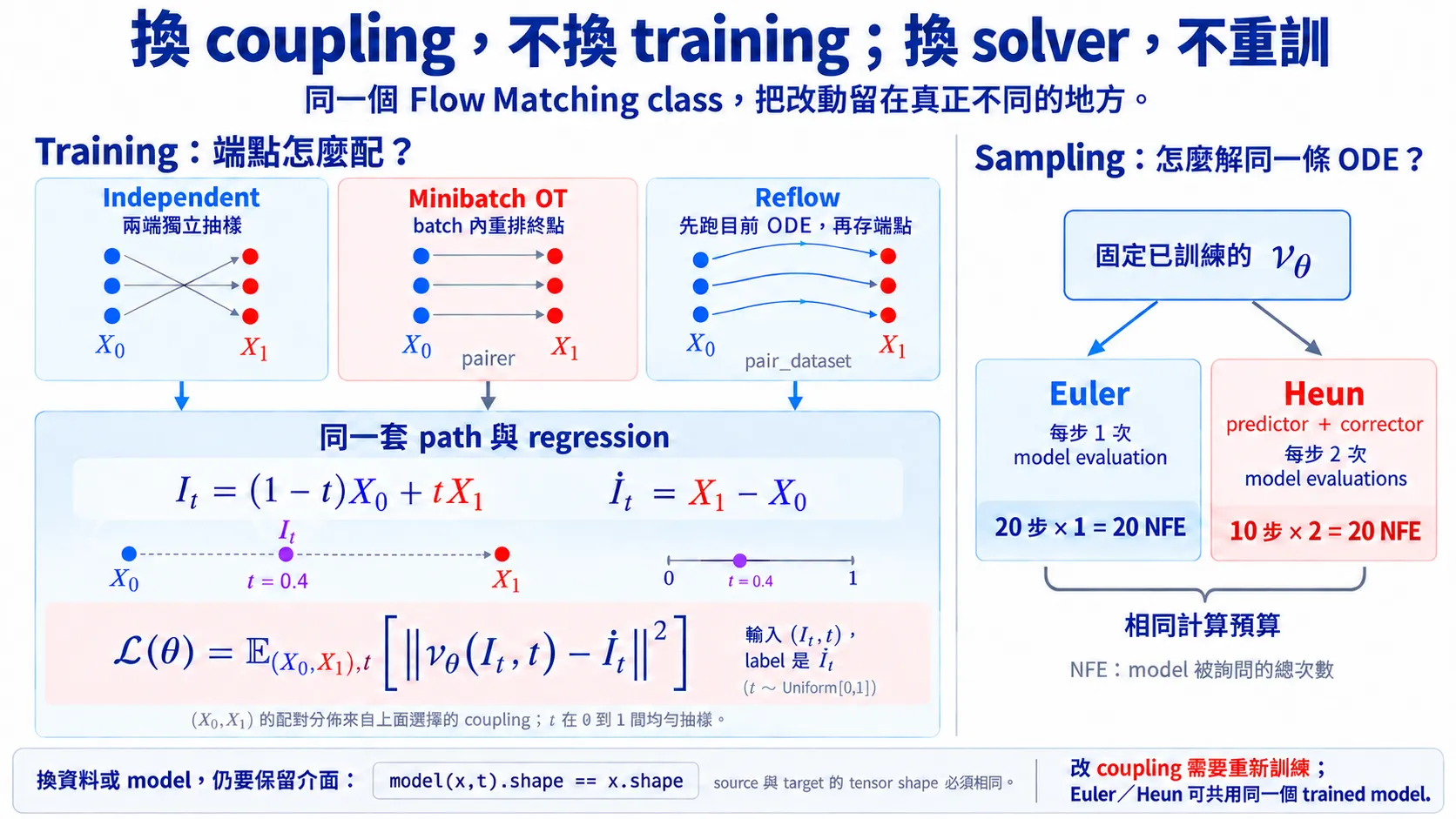
圖:改 coupling 與改 solver,是不同的程式改動。 左邊改的是 training pairs:minibatch OT 用 pairer 重排目前 batch,Reflow 用 pair_dataset 保存目前 ODE 產生的端點配對;三者共用相同的 path 與 velocity regression。右邊固定 trained model,只改積分方法;Euler 20 步與 Heun 10 步同樣使用 20 NFE。圖中的配對與路徑是示意,不是實測結果。
課堂提問Q1
如果要把這份程式從 two moons 換到影像資料,只更換 target_sampler 就夠了嗎?
先想一想,再展開看整理後的答案
不夠。至少要一起確認三個介面:
source_sampler與target_sampler必須回傳相同 shape,例如[batch,3,32,32];- 外部傳入的 model 必須接受
(x,t),並輸出和影像相同 shape 的 velocity; - 記憶體是否允許 minibatch OT 建立 cost matrix。
FlowMatching.fit、Reflow 的 fixed-pair training 與 Euler/Heun integration 不必因為資料從二維點換成影像而重寫。真正需要換的是資料與 model;minibatch OT 的 batch size 則要依計算成本重新選擇。
快速回顧一下
把二維 toy 換成自己的問題
- 把
sample_two_moons換成另一個二維 distribution,觀察哪些程式完全不需要改動。 - 把
VelocityMLP換成自己的 model,並保留model(x,t).shape == x.shape這個介面。 - 改變 minibatch OT 的 batch size,記錄 training time 與 Euler sampling 的結果。
- 再做一輪 Reflow,分開記錄「產生 pairs」與「重新 training」各自需要的時間。
參考文獻
- Lipman, Y., et al. Flow Matching for Generative Modeling. ICLR 2023. (Linear Conditional Flow Matching。)
- Liu, X., Gong, C., Liu, Q. Flow Straight and Fast: Learning to Generate and Transfer Data with Rectified Flow. ICLR 2023. (Rectification 與 Reflow。)
- Tong, A., et al. Improving and Generalizing Flow-Based Generative Models with Minibatch Optimal Transport. TMLR 2024. (Minibatch OT coupling。)
- Karras, T., Aittala, M., Aila, T., Laine, S. Elucidating the Design Space of Diffusion-Based Generative Models. NeurIPS 2022. (Heun sampling 與 NFE 比較。)