
M4.3 Can You Detect a Reversed Movie? Time Reversal and Probability Ratios
Builds on2 notes
A record without timestamps
A weather record contains sunny, cloudy, and rainy states with transition times, but no dates or sun positions. Can you tell whether it runs forward or backward? Model it as a finite-state CTMC and compare transition laws.
Consider two questions:
- What statistical evidence could reveal the direction?
- Would your answer change if there were only sunny and rainy states?
Randomness does not imply time symmetry. A preference for sunny→cloudy→rainy→sunny reverses under playback. Given the current state, where was the process just before? This is another Bayes question.
DiscussionQ1
For , is the reversed process Markov, and what are its rates?
Show the reasoning
Under the usual finite-state setting, time reversal remains Markov. Conditional on the present, past and future are independent, a symmetric statement in their roles.
The rates generally change. Forward rates describe the next state; reverse rates infer the previous state from the present. Bayes weights each possible origin by its prior probability and likelihood of reaching the observation, then normalizes. We need the short-time slope of that posterior.
Rooms and circulation
Imagine people moving between sunny and rainy rooms. Reversing the movie exchanges the directions of each crossing. At stationary two-room balance, both flows agree, leaving the same statistical law.
With three rooms, balanced total inflow and outflow can coexist with a preferred cycle. Reversal changes that circulation direction. Two states cannot support such a cyclic current; three can.
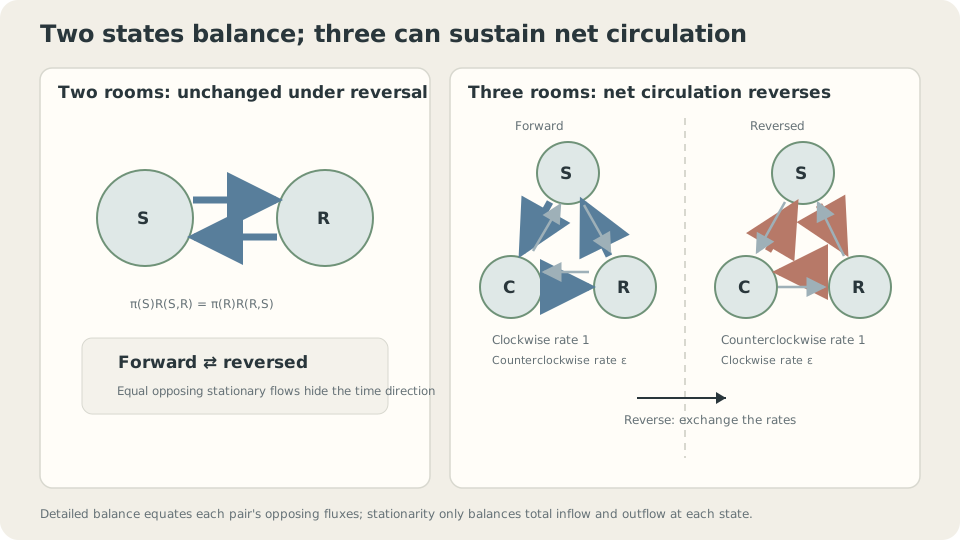
Stationary two-state flow balances pairwise; three states can maintain a directed circulation.
Derive the reverse rule
Bayes over a short interval
Let be the law of a finite-state CTMC. Restrict to and distinct . Ask for the probability that given :
Use
and . Divide by to obtain
Choose diagonal entries so rows sum to zero. The numerator combines the forward likelihood rate and origin prior ; the denominator is the limiting evidence. Reversal needs both transition tendencies and the current population allocation.
The subscript refers to forward time. Under reverse clock , the generator is . It usually varies with time even if is constant. Do not divide by zero-probability states; support and endpoint behavior require care.
When is reversal statistically invisible?
At stationarity , reverse rates are time-independent. Equality with the forward rates requires
This is detailed balance; the stationary process is reversible. It balances every pair, stronger than global balance , which only balances each state’s total inflow and outflow.
Two states: the sole independent stationary balance equation is already detailed balance. A stationary two-state CTMC and its reversal therefore have identical path laws. This concerns statistical laws, not deterministic identification of a particular observed segment.
Three-state cycle: set clockwise rates to one and counterclockwise rates to . Symmetry gives uniform . Reversal transposes off-diagonal rates, exchanging the two tendencies. At , detailed balance holds; for small positive , counts of directed transitions can reveal a statistical preference.
DetailsReversed marginals, discrete-time reversal, and a cycle criterion
Set and . Substituting reverse rates into gives
Thus the reversed forward equation moves the marginal law backward as required.
In discrete time, Bayes gives . At stationarity it becomes , and detailed balance is .
Kolmogorov’s criterion characterizes reversibility of an irreducible chain by equality of forward and reverse rate products around every cycle. For the triangle, these products are one and , agreeing only at [1].
Revisit the intuition
“Random looks random backward” is insufficient. Stationary reversibility makes the laws exactly equal, while a stationary circulation can break that symmetry. Long holding times alone do not establish a direction of time.
Stationarity matters. A reversible generator started away from equilibrium can have time-dependent reverse rates. For sunny→rainy rate 0.2, rainy→sunny rate 0.4, and an all-sunny start, . The reverse rainy→sunny rate is , behaving like near zero. Reversed paths must return to the prescribed sunny start. This gives distributional direction information without guaranteeing identification from one short record.
Try it
import numpy as np
rng = np.random.default_rng(0)
eps, T = .2, 200000
R = np.array([[-(1+eps),1,eps],[eps,-(1+eps),1],[1,eps,-(1+eps)]])
x, path = 0, []
for _ in range(T):
    rates = R[x].copy()
    rates[x] = 0
    x = rng.choice(3,p=rates/rates.sum())
    path.append(x)
path = np.array(path)
cw = np.mean((path[1:]-path[:-1])%3==1)
print('clockwise fraction, forward and reversed:',cw,1-cw)
# Equal exit rates make jump counts especially simple here.
Check your understanding
References
- Kelly, F. P. Reversibility and Stochastic Networks. Wiley, 1979.
- Norris, J. R. Markov Chains. Cambridge University Press, 1997.
- Levin, D. A., Peres, Y. Markov Chains and Mixing Times, 2nd ed. AMS, 2017.