U3.5 Lab: Reuse the Methods with New Data and Models
Builds on2 notes
Reflow and minibatch OT change training pairs. Heun instead improves numerical approximation of an already trained ODE.
If every choice requires a new training loop, we lose sight of what actually changes between methods.
Can one shared training class expose only the parts that differ?
What will this program produce?
The example transports a Gaussian source to two moons. Download it here:
Download the Flow Matching, Reflow, minibatch OT, and Heun script
Install dependencies:
pip install torch numpy scipy matplotlibRun:
python dma-u3-flow-matching-reflow-ot-lab.pyThe script trains an independent-pair baseline, changes pairing through Reflow and minibatch OT, and writes u3_5_results.png. It also fixes the baseline model to compare Euler and Heun at equal NFE. Changing coupling changes the learned ODE; changing solver changes its approximation.
For a shorter environment check, use
python dma-u3-flow-matching-reflow-ot-lab.py --steps 100 --reflow-pairs 1000 --eval-samples 500Does changing the model require rewriting Flow Matching?
Two-dimensional data may use an MLP; images may use a U-Net. Hard-coding either architecture inside the training class would couple unrelated choices.
Build the model externally and pass it into FlowMatching:
model = VelocityMLP(data_dim=2, hidden_dim=128)
device = "cuda" if torch.cuda.is_available() else "cpu"

fm = FlowMatching(
    model=model,
    source_sampler=sample_gaussian,
    target_sampler=sample_two_moons,
    device=device,
)
The required interface is
model(x, t).shape == x.shapeGiven state and time, return velocity with the same shape as the state. Replacing the architecture leaves the learned mathematical object unchanged.
Pass data sampling functions externally too. Source and target samplers must return tensors with matching shapes.
InterfaceWhich parts can be replaced independently?
The example exposes
model: the velocity approximator.source_samplerandtarget_sampler: the endpoint laws.path: the reference position and derivative for a given pair and time.pairerorpair_dataset: endpoint coupling.
The example uses linear interpolation, but accepts another path function. Identify which mathematical choice changes before replacing its corresponding interface.
Which quantities does every training step need?
Every architecture uses a reference position and reference velocity. For a linear path,
def linear_path(x0, x1, t):
    tau = t.reshape(t.shape[0], *([1] * (x0.ndim - 1)))
    xt = (1 - tau) * x0 + tau * x1
    reference_velocity = x1 - x0
    return xt, reference_velocity
Reshaping time makes it broadcast across every non-batch dimension, supporting both [batch,2] points and image tensors.
Given the position and derivative, training uses the same objective:
x0, x1 = self._draw_pairs(
    batch_size,
    pairer=pairer,
    pair_dataset=pair_dataset,
)
t = torch.rand(batch_size, device=self.device)
xt, reference_velocity = self.path(x0, x1, t)

prediction = self.model(xt, t)
loss = F.mse_loss(prediction, reference_velocity)

self.optimizer.zero_grad(set_to_none=True)
loss.backward()
self.optimizer.step()
Independent pairing, minibatch OT, and Reflow share this MSE. Their difference is the endpoint pair returned by _draw_pairs.
Begin with independent pairing
Without a pairer or paired dataset, draw source and target independently:
baseline = FlowMatching(
    model=VelocityMLP(),
    source_sampler=sample_gaussian,
    target_sampler=sample_two_moons,
)

baseline.fit(steps=2500, batch_size=256)
This is linear CFM [1]. Both coupling methods below retain its interpolation and objective.
Which operation changes for minibatch OT?
Before drawing reference lines, reorder targets to minimize batch transport cost. Encapsulate this in a pairer:
def minibatch_ot_pair(x0, x1):
    from scipy.optimize import linear_sum_assignment

    flat_x0 = x0.detach().flatten(1)
    flat_x1 = x1.detach().flatten(1)
    cost = torch.cdist(flat_x0, flat_x1).square().cpu().numpy()
    rows, cols = linear_sum_assignment(cost)

    rows = torch.as_tensor(rows, device=x0.device)
    cols = torch.as_tensor(cols, device=x1.device)
    return x0[rows], x1[cols]
Flattening each sample permits a shared Euclidean-cost implementation for points and images. The matrix is still , and larger batches increase memory and assignment cost. Meaningful image costs may require a different representation.
Pass the pairer into the same training method:
batch_ot = FlowMatching(
    model=VelocityMLP(),
    source_sampler=sample_gaussian,
    target_sampler=sample_two_moons,
)

batch_ot.fit(
    steps=2500,
    batch_size=128,
    pairer=minibatch_ot_pair,
)
Each step draws fresh batches, then permutes target order. No samples are added or removed, so both empirical marginals are preserved.
Where do Reflow pairs come from?
Reflow [2] does not solve batch assignment. Draw sources and integrate the current model:
reflow_pairs = baseline.make_reflow_dataset(
    n_samples=20000,
    batch_size=1024,
    n_steps=50,
    solver="heun",
)
The resulting joint is
Store each source with its actual generated endpoint. Build a new model and train on straight references between these fixed pairs:
reflow = FlowMatching(
    model=VelocityMLP(),
    source_sampler=sample_gaussian,
    target_sampler=sample_two_moons,
)

reflow.fit(
    steps=2500,
    batch_size=256,
    pair_dataset=reflow_pairs,
)
The paired dataset replaces independent sampling; path, objective, and optimizer logic remain shared. Further rounds generate new pairs and retrain again.
ImplementationWhy generate pairs using a finer Heun solve?
Ideal rectification uses exact endpoints. Numerical error in generated pairs becomes part of next-round training data.
The example uses 50 Heun steps to reduce that contribution, rather than because Reflow requires this solver. Refine the grid and compare endpoints to check adequacy.
How should we compare Euler and Heun fairly?
After coupling determines training data, sampling still needs an integration rule. The implementation supports
if solver == "euler":
    x = x + h * v0
else:
    predicted = x + h * v0
    v1 = self.model(predicted, t1)
    x = x + 0.5 * h * (v0 + v1)
Euler costs one call per step and Heun two. With 20 NFE, compare
x_euler = baseline.integrate(x0, n_steps=20, solver="euler")
x_heun  = baseline.integrate(x0, n_steps=10, solver="heun")
Twenty steps of each would compare 20 with 40 calls, conflating numerical method with budget.
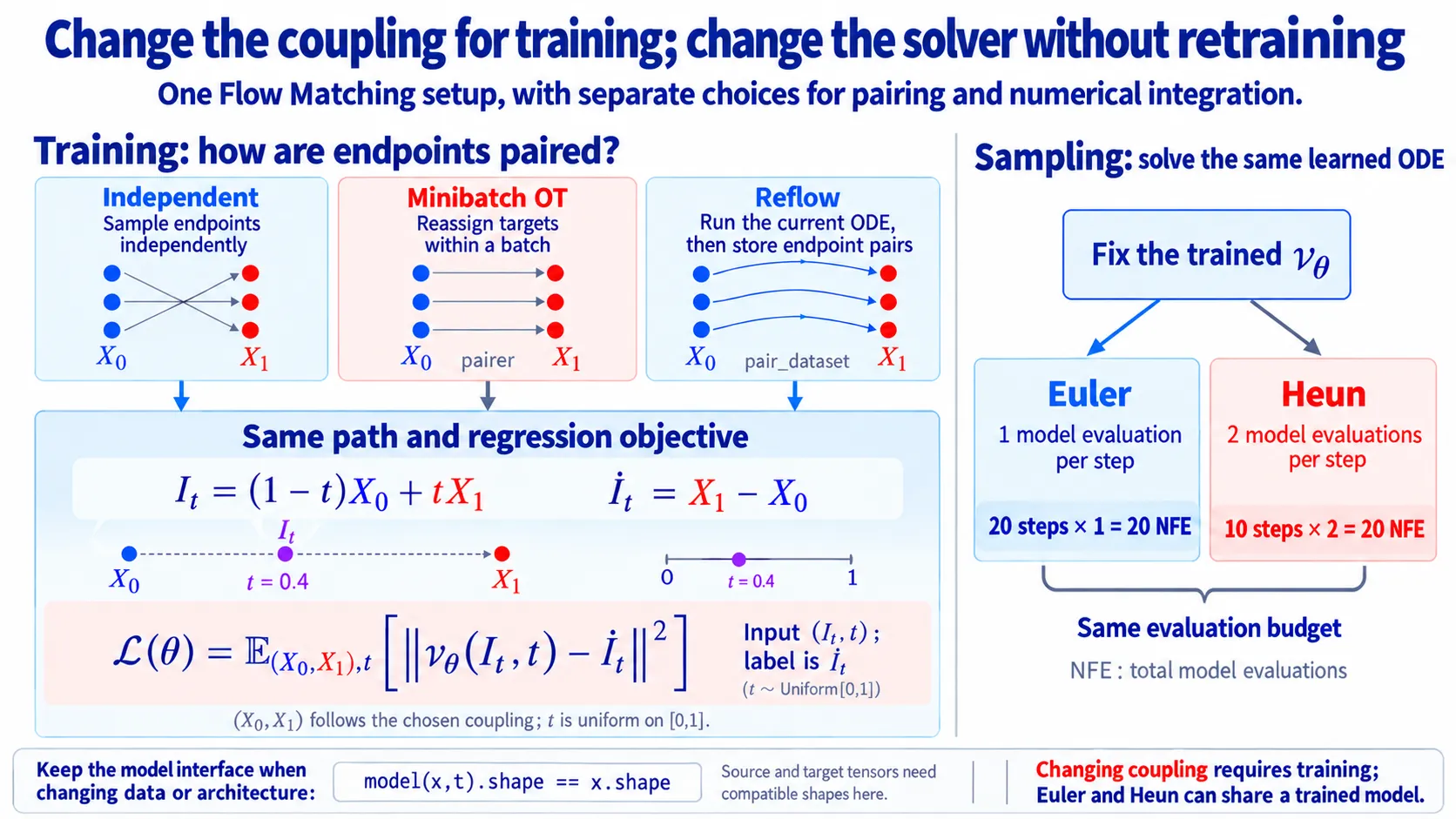
Figure: coupling and solver changes occur in different parts of the code. A pairer reorders each batch; a paired dataset stores Reflow endpoints. All use common interpolation and regression. The diagram is schematic, rather than an experimental result.
DiscussionQ1
To move from two moons to images, is replacing only target_sampler enough?
Show the reasoning
No. Check the following interfaces together:
- Source and target must return matching shapes, such as
[batch,3,32,32]. - The external model must accept image state and time and return matching velocity shape.
- Batch OT’s matrix and assignment cost must fit the available resources.
The shared training, fixed-pair training, and integration logic need not be rewritten merely because state dimension changes. Replace data and architecture, then choose a feasible batch size and suitable cost.
Check your understanding
Replace the toy with your own problem
- Replace the target with another 2D law and identify unchanged code.
- Substitute your own model while retaining the shape contract.
- Vary OT batch size and record training time and sampling behavior.
- Add another Reflow round, separately timing pair generation and retraining.
References
- Lipman, Y., et al. Flow Matching for Generative Modeling. ICLR 2023.
- Liu, X., Gong, C., Liu, Q. Flow Straight and Fast: Learning to Generate and Transfer Data with Rectified Flow. ICLR 2023.
- Tong, A., et al. Improving and Generalizing Flow-Based Generative Models with Minibatch Optimal Transport. TMLR 2024.
- Karras, T., Aittala, M., Aila, T., Laine, S. Elucidating the Design Space of Diffusion-Based Generative Models. NeurIPS 2022.