U2.0 Is a Forward Corruption Process Necessary?
Builds on1 note
One endpoint of our diffusion construction is Gaussian
In U1, Gaussian noise made sampling and conditional calculations convenient. We generated data by reversing a chosen corruption process.
What if we instead want to transport one prescribed distribution directly into another?
If the input is a real photograph and the output should have a cartoon style,
why should the source have to be Gaussian noise?
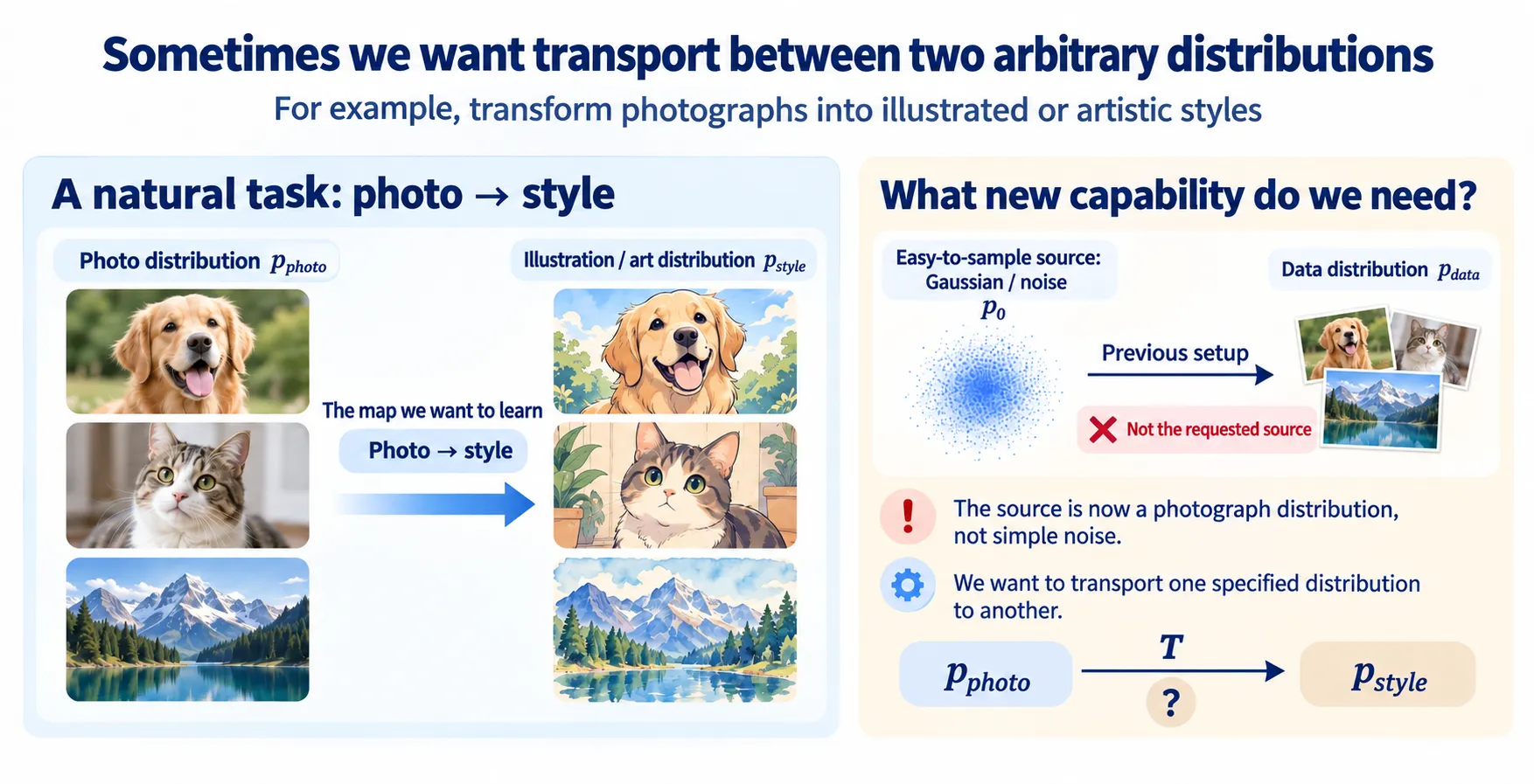
Our diffusion setup was
Now we want to handle
where neither endpoint must be Gaussian. This motivates a different setup; it does not claim diffusion methods cannot be adapted to such applications.
Revisit the strategy from Unit 1
We first sought a one-shot transport map, then constructed intermediate noisy states and learned local corrections. DDIM showed that local movements can form a deterministic flow.
This suggests a natural question:
Given endpoint random variables, can we choose intermediate positions and learn a flow between them?
Imagine rearranging sand from one shape into another. Each grain’s position changes with time; velocity describes that change.
We therefore seek a velocity field:
answers a local question: where should a particle at this position and time move, and how fast? Repeating this motion transports the population.
The ODE explains how to move once we know the field, but does not yet provide it.
Lipman and colleagues’ Flow Matching [1] addresses this gap by constructing reference paths and learning their marginal velocity field.
Check your understanding
References
- Lipman, Y., Chen, R. T. Q., Ben-Hamu, H., Nickel, M., Le, M. Flow Matching for Generative Modeling. ICLR 2023.