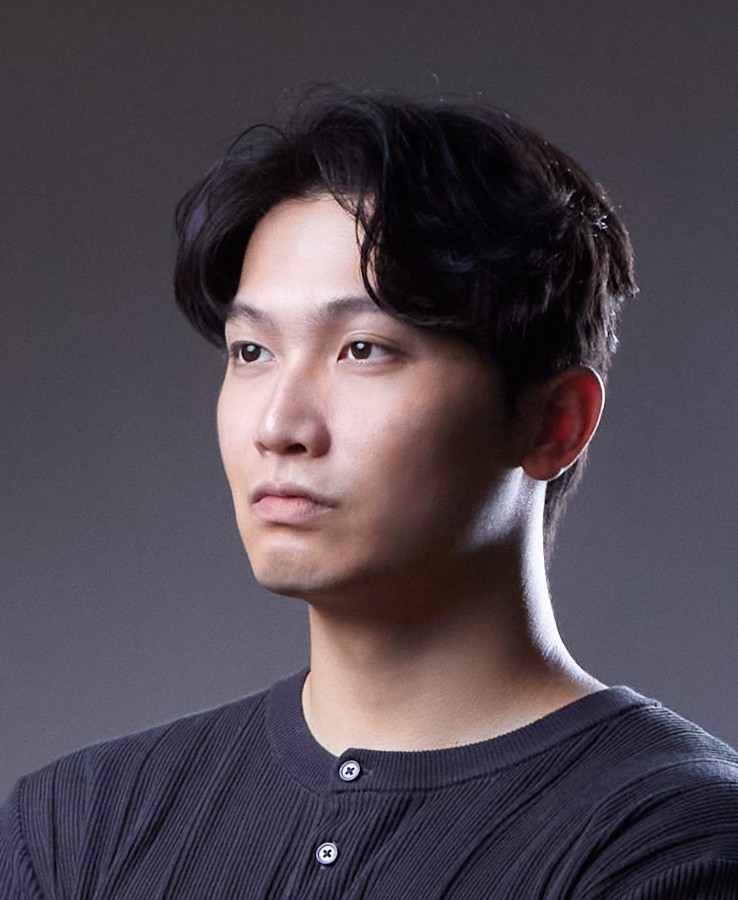
Assistant Professor · CSIE, National Taiwan University
Shih-Hsin Wang 王士欣
I work on geometric deep learning, generative models and AI for Science, turning intuition into principled and practical tools.


Choose a path to explore
More about my research
I develop machine learning methods that are both theoretically grounded and practical, spanning geometric deep learning, generative models, and AI for Science. I care about turning intuition into principled, reliable, and efficient tools — and applying them to problems in molecules, biology, and other sciences.
Notes
All notes →Courses
Diffusion Models and Their Applications From diffusion models and flow matching to discrete generation, one-step models, and guidance at generation time. Geometric Deep Learning Designing machine learning models around the geometric and symmetry structure in data: graph neural networks, invariance and equivariance, and applications to molecules, proteins and other structured data.
Foundations
Mathematical Foundations A plain-language introduction to the mathematical tools that recur in machine learning, and to the mathematics the other courses on this site rely on. Machine Learning Foundations The core concepts, methods and practice of machine learning — the basis for understanding, analyzing and applying different models.
Academic Skills
Recent
Experience →Aug 2026
Undergraduate project places are full for now; MS/PhD depends on capacity. See Join the Lab for where things stand and how to apply.
Jul 2026
I was named a Yushan Young Fellow by Taiwan's Ministry of Education (Yushan Fellow Program).
Jul 2026
I am organizing two minisymposia on generative models, transport, and inverse problems at SIAM IS26 & MDS26 (Salt Lake City, Nov 2026). [Details]
Jul 2026
I will join the Department of Computer Science and Information Engineering at National Taiwan University as an Assistant Professor in August 2026.
Research
- Geometric Deep Learning Equivariant graph neural networks and expressive geometric graph representations.
- Generative Models Diffusion models, flow matching, single-step models, and test-time guidance.
- AI for Science Modeling complex structures like molecules and proteins.
Selected publications
All publications → FdAudio: MeanFlow-Anchored Fréchet-Distance Post-Training for One-Step Text-to-Audio Generation
SLT 2026
Test-Time Sequential Steering of Diffusion Models via Preconditioned Crank-Nicolson
NeurIPS 2026
ICML 2026 GenBio [Spotlight]